
Why learning to work with discomfort—not avoiding it—is a critical development skill for today’s workforce.

.jpg)
Growth rarely happens where things feel easy, familiar, or comfortable. Yet in the workplace—and often in life—we tend to treat discomfort as something to avoid rather than something to work with.
As HR professionals, coaches, and people leaders, we often encourage others to step outside their comfort zones: take on a stretch role, speak up more, lead a new initiative, or experiment with a new way of working. Without the right framing and support, however, “get out of your comfort zone” can feel vague, overwhelming, or even unsafe.
Over the past few years, I’ve been experimenting with what I call discomfort zone projects—intentional challenges outside of work that stretch me in manageable, supported ways. These experiences didn’t just help me build skills outside of work. They grew my confidence, expanded my sense of what I was capable of, and changed my relationship with discomfort itself. Those benefits carried into my work, where I became more confident navigating uncertainty, stretch assignments, and my own potential.
What I learned is simple but powerful: discomfort is a compass for growth. The real question isn’t how to eliminate discomfort, but how to engage with it skillfully.
Below are five practical principles you can use yourself—or to support others—in navigating the discomfort zone.
In a spin class, no one tells you to crank the resistance all the way up at once. You’re guided to increase it gradually, allowing your body and mind to adjust. You feel challenged, but not overwhelmed.
Growth works the same way. When people jump straight into high-stakes discomfort—major role shifts, public failures, identity-level changes—the nervous system often goes into protection mode. The result isn’t learning, but shutdown, avoidance, or burnout.
How to apply this principle:
Incremental discomfort builds trust—in the process and in oneself. It also makes it manageable.
Discomfort requires energy. If someone’s system is already depleted, adding challenges without support can be counterproductive.
When I take on a discomfort project, I balance it with familiar, grounding activities—maintaining routines, enjoying my favorite things to do, or focusing on calming activities.
How to apply this principle:
Growth isn’t about constant pressure. It’s about oscillation—challenge and support working together.
This year, I picked up pickleball—not to win tournaments, but to learn something new. What surprised me was how much I enjoyed the process: play, movement, and being a beginner again.
When we fixate on outcomes—winning, being good, proving ourselves—discomfort quickly turns into fear of failure. When we focus on the process, discomfort can invite curiosity.
How to apply this principle:
A process orientation lowers the emotional cost of trying—and increases persistence.
Any stretch beyond what’s familiar can invite the inner critic. It’s fast, persuasive, and often harsh—but usually well-intentioned, trying to protect us from embarrassment or rejection.
The issue isn’t that the inner critic appears. It’s when we believe everything it says. In my own discomfort projects, I’ve learned to expect the voice and observe it rather than let it be in the driver’s seat. Naming it creates space.
How to apply this principle:
When people stop fighting the inner critic, it loses much of its power.
Discomfort shows up differently for everyone—anxiety, frustration, perfectionism, avoidance.
Helping people notice these patterns builds agency. Questions like:
With awareness, people can increase their tolerance for discomfort gradually and safely.
How to apply this principle:
Discomfort isn’t a sign something has gone wrong. More often, it’s evidence that growth is underway.
Shift from pushing people out of their comfort zones to helping them build a healthy relationship with discomfort. When leaders support growth this way, they unlock confidence, resilience, and untapped potential—and help employees expand what feels possible.
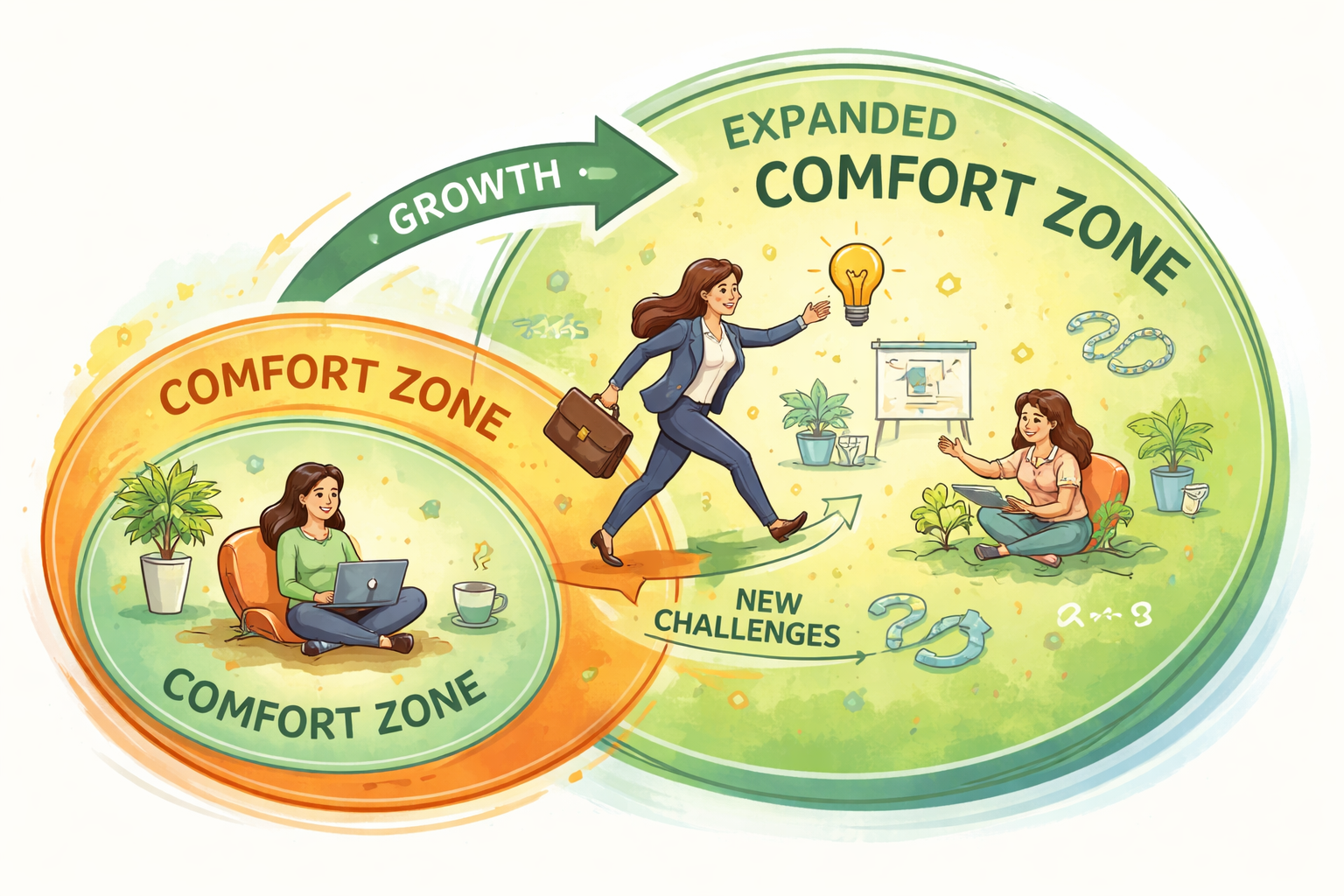
The goal isn’t to live in discomfort. It’s to know how to enter it, grow from it, and create a new expanded comfort zone.


.jpg)
.jpg)
.jpg)
.jpg)
.png)
.jpg)
.jpg)

