
What we don’t tell new directors, and what people leaders can do

.jpg)
After I gave a talk on the director transition, a message landed in my inbox.
“The way you described what it feels like to be a new director, trying to navigate it all on your own with little direction and what a big leap it was…I felt all of that. I didn’t realize I was carrying it so heavily. I didn’t know if I was doing a good job, but I didn’t realize how much it affected me. But I can see it now and I’m trying to figure out how to make the leap and know what good looks like in my role.”
It wasn’t the first time I’d heard a story like this. As a COO, head of people, and leadership coach, I’d heard some version of this many times from new directors. The confusion, the feeling like they were missing something, the sudden realization that the leap from manager to director was much bigger than they anticipated.
I also heard about it from the other direction. A VP or C-suite leader would come to me with some version of the same opening: “I’ve got this new director. They’re struggling. I’m not sure they were ready for the role. I’m not sure they can make it. What should I do?” Sometimes that conversation came with a follow-up question: how do I reflect this on their performance review, or do I need to put them on a PIP?
Often, the senior leader had already formed a conclusion: the person wasn’t ready or cut out for the role. Rather than agree with their assessment, I asked more questions. What kind of training or development had they had? What had already been tried? How had the transition into the role been marked? How clearly had expectations been shared? How directly and how frequently had those conversations happened?
As people leaders, we've seen this pattern over and over. The answer is usually the same. Little to no training. An informal transition. Expectations shared once before the role started and not revisited. Feedback that wasn't direct, deep, or frequent enough. It falls to us to figure out what to do with all of it. Whether to recommend a PIP. Whether to push back on the senior leader's conclusion. Whether this person can still make it or whether the window has closed. It's a judgment call made with incomplete information, under pressure, about someone's career. And, we're often the only ones in the room who can see the full picture.
And the stakes are higher than they look on paper. A director who can’t make the leap doesn’t just underperform. They create drag. Teams lose focus. Strategic priorities get crowded out by the noise. And by the time it becomes a formal performance conversation, the organization has already paid a significant cost.
New leaders don’t understand how big the gap is until they fall into it. And neither do the senior leaders who are managing them. The new role requires a fundamentally different orientation. From tactical and narrow to broad and strategic. From doer (or close to the doing) to connector. From optimizing a function to understanding how the whole system works and our role in it.
Senior leaders expect them to figure it out. As if a role description is enough. By contrast, new directors experience it like being plunged into the deep end of the pool with no floaties and no lessons on how to swim.
Competency frameworks are useful. If you don’t have one for your directors and VPs, building one is worth the effort. But even a good competency framework describes the destination. It doesn’t name the journey. It doesn’t tell you how big the leap is.
Senior leaders often don’t have a mental model for that leap either. Most of them forgot how big the shift was, muddled through it on their own, or if they got lucky had a coach, a formal mentor, or a leadership development program. The other shorthand they reach for — management versus leadership — collapses two different kinds of work into one category and leaves everyone without a map for what actually changes when someone moves into a director role.
Nobody in that room has the language. Not the VP. Not the director. I built the Leadership Domains framework after years of having these conversations because the tools didn't exist. The conversations I was having are the same ones people leaders are having now and they're happening faster, with less support, and under more pressure than ever.
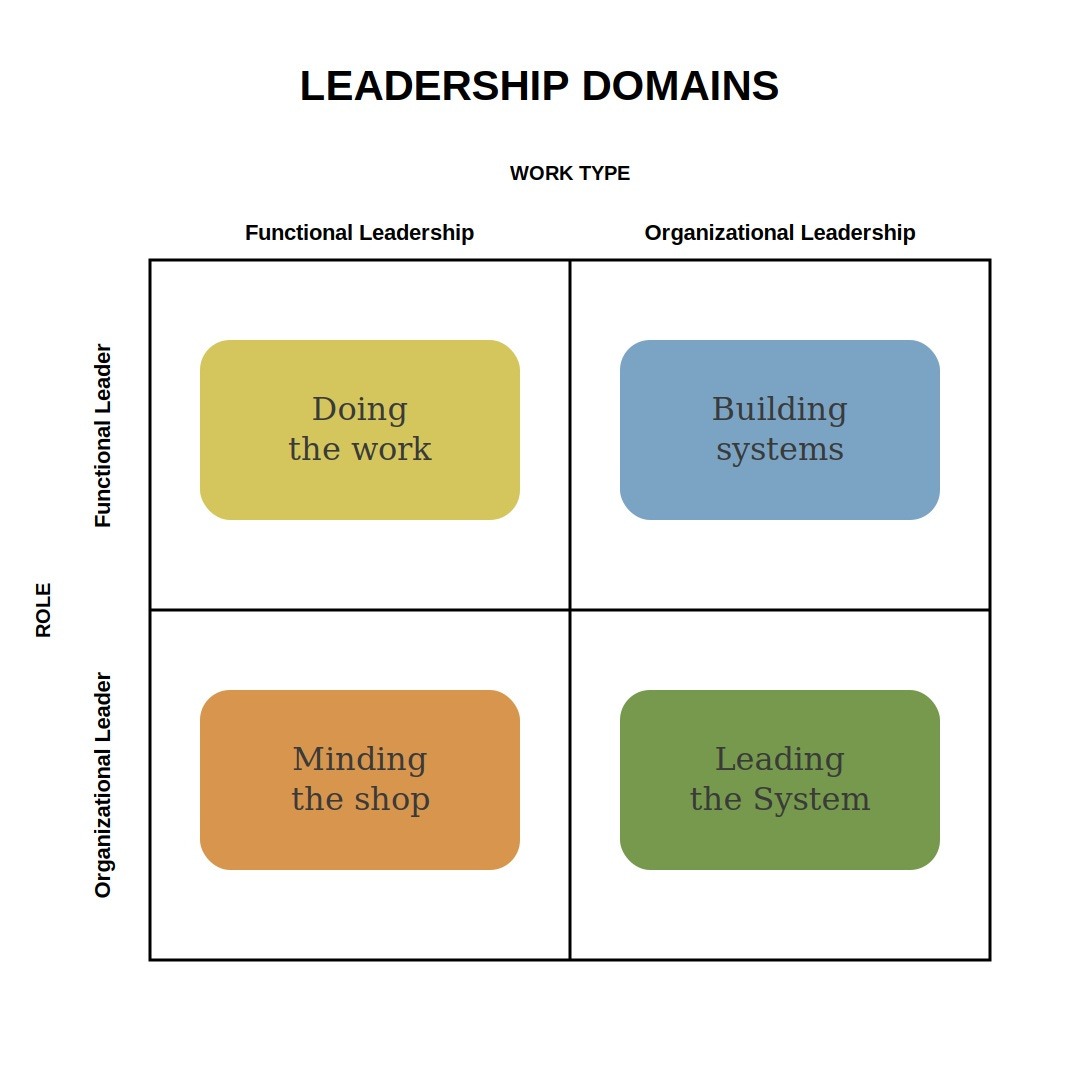
The director role is the first time most leaders are asked to operate as organizational leaders, not just functional ones. That's the leap — from functional leadership to organizational leadership. And most people don't see it coming.
The Leadership Domains framework maps two things: the type of work being done and the role doing it. Most new directors are deeply familiar with the top row — Doing the Work and Building Systems. That’s where they lived before the promotion. That’s what got them here. It’s also what gets them in trouble and what makes their boss say they’re a performance problem.
The bottom row is new territory. Minding the Shop and Leading the System are the domains of organizational leadership. And most new directors arrive there without a map.
Minding the Shop is where most struggling new directors live. They stay inside their function. They go down into the work and occasionally manage up, but rarely go across. They don’t build the peer relationships across the organization that the role requires. They lose sight of the larger strategic objectives.
All organizational leaders spend time in Minding the Shop. The key is the ratio. When we spend too much time there, we miss what the role actually requires: Leading the System.
For organizational leaders, success in your function is table stakes, not the whole role. That’s the reframe most new directors need to hear.
This is where people leaders can do their most valuable work. Not just by building a program, but by having a better conversation.
With a struggling director, show them the map. Help them locate where they are and where the role actually requires them to be. That reframe alone can change how they see the problem. When directors can see the domain they're supposed to be operating in, something shifts. They stop measuring themselves against the wrong things. They start building the relationships the role requires. They stay at the right altitude.
With a senior leader calling it a performance problem, the conversation is different. Help them understand how big that leap actually is, and how the skills that got someone promoted are not the same skills the new role requires. The Leadership Domains framework gives them language they can take directly into their next conversation. They can name the specific gaps, and shift from managing a performance problem to supporting the leap into organizational leadership.
You already know this problem. You’ve seen it play out over and over. What’s been missing isn’t insight, it’s language. Language that works with a VP who’s ready to write someone off. Language that helps a struggling director see what’s actually being asked of them. Language that makes the case to an exec team that the director role is organizational, not just a bigger functional one.
When you have that language, the translation gets easier. And the leaders who might have been written off get a real shot at making the leap.


.png)
.jpg)
.jpg)
.png)
.jpg)
.jpg)
.jpg)

