
Closing the Gap Between Learning and Doing


A few years ago I was coaching a manager who had just been promoted. She was brilliant, a top performer, deeply respected, the kind of cultural evangelist the CEO looked to. Three months in, she said something I now hear constantly.
“I feel like I’m failing.”
Then she told me why:
“I know what I’m supposed to do. I’ve read the books. I attended the workshop. But when it happens, when someone on my team is underperforming or I need to give difficult feedback, I freeze.”
That conversation is a big part of why I founded Oxygen. Because the problem in most organizations isn’t that managers don’t know what to do. They know what to do. They just don’t know how to do it in the moments that matter most. That’s the gap I want to talk about, and it’s the gap reshaping how the best companies develop their managers right now.
If you work in HR or people operations, you see the symptoms before anyone else does. Difficult conversations that never happen. Performance issues that escalate to your desk. Great employees who struggle after a promotion. The stakes are high, because managers influence performance, engagement, culture, and retention, and yet most people step into the role with very little preparation.
It’s tempting to read those symptoms as a knowledge gap, so we send managers to a workshop and hope it sticks. But most managers already understand the concepts. They can describe good feedback. They know they should set clear expectations and hold people accountable. They’ve done the reading.
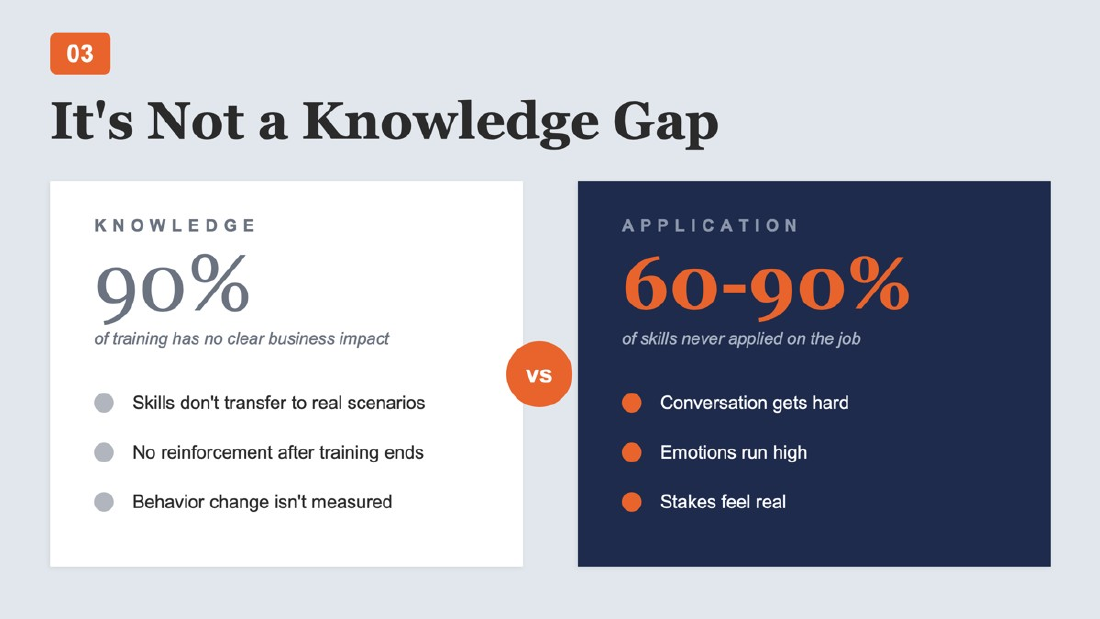
What they struggle with is application.
“When the moment arrives and those emotions are really high and they’re in that uncomfortable setting, they struggle to apply the skill. That’s what I call the application gap. And when companies start measuring it, they’re often shocked by how large it is.”
Studies estimate that 60 to 90 percent of the skills learned in training are never applied on the job. From an HR perspective, that gap has a real cost: when managers can’t hold the hard conversation, you become the escalation point for the emotional labor they were meant to handle.
To understand why this happens, it helps to step back and ask a simpler question. How do adults actually learn complex skills? Management isn’t really theoretical knowledge. It’s a behavioral skill, and the good news is that it can be taught.
For centuries, the gold standard has been the apprenticeship model. Think about carpentry, electrical work, or cooking. You don’t learn those from a handbook. You watch someone experienced, you try it yourself, you make mistakes, you get feedback, and you repeat. Responsibility grows gradually, and mistakes are expected and coached in real time.
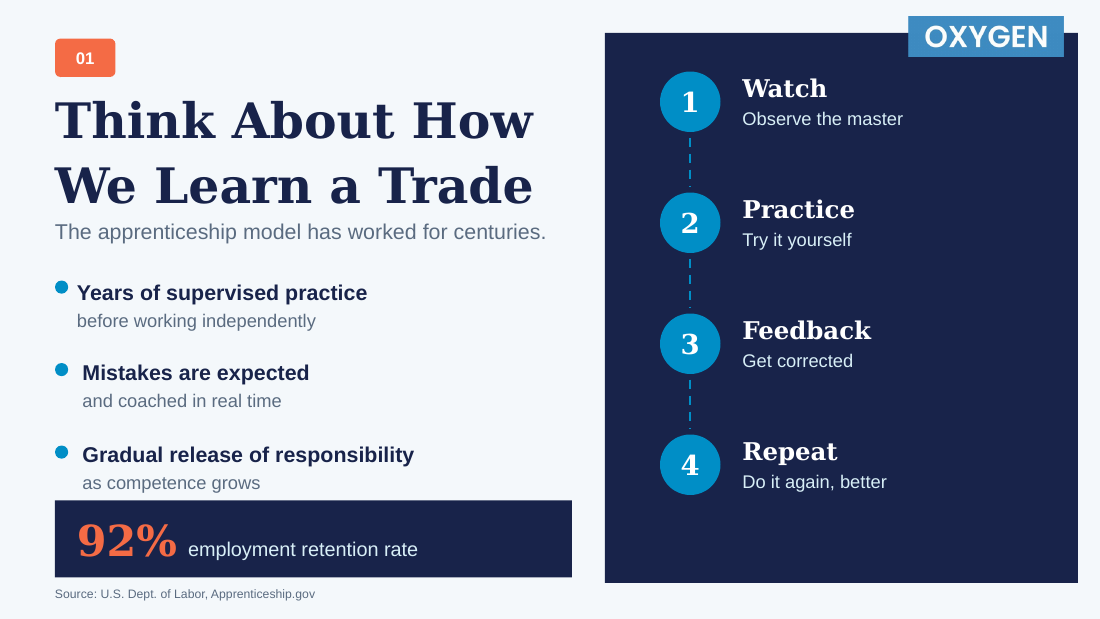
It works extraordinarily well. Under the apprenticeship model, about 92 percent of employees stay in their roles. Now imagine if surgeons learned the way managers usually do. They read a book, attend a workshop, then Monday morning walk in and say, “Alright, open heart surgery, let’s give this a try.” That would be absurd, yet it’s surprisingly close to how most of us develop managers: we promote our best individual contributors, hand them a policy handbook, and tell them to figure it out.
Because mistakes feel career-threatening, managers default to avoiding difficult conversations, micromanaging, or simply copying the management style they happened to experience themselves. So here’s the question I keep coming back to: why do we invest years in learning a trade, but expect managers to figure it out overnight?
The answer starts with how skill retention actually works. We remember very little of what we hear in a lecture, far more of what we practice by doing, and the most of all when we teach it to someone else.
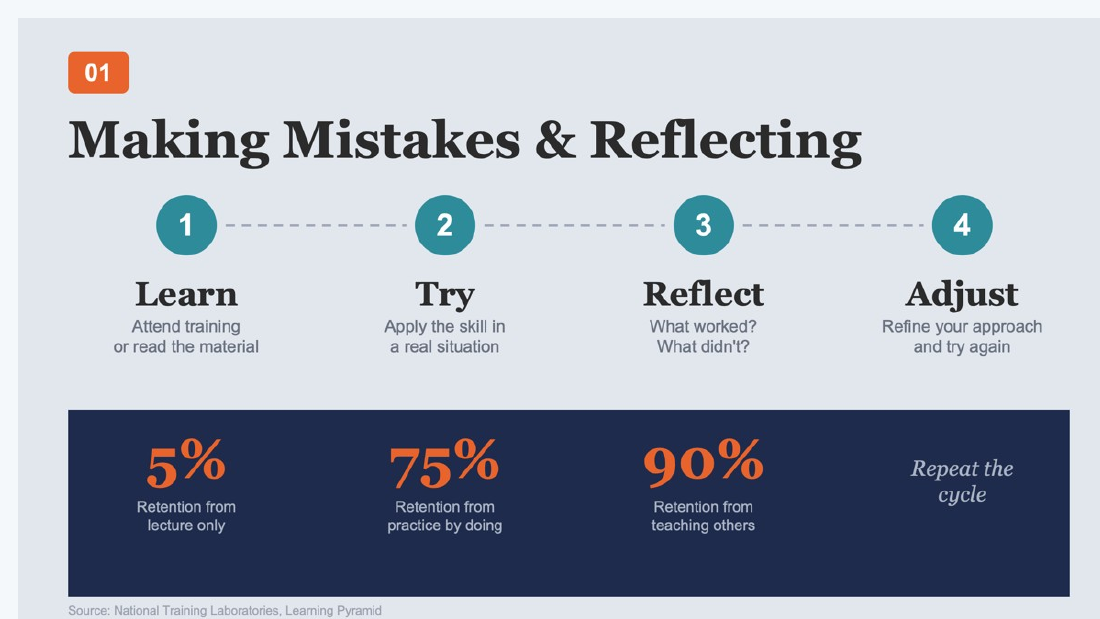
I was floored when I first saw these numbers: 5 percent retention from lecture alone, 75 percent from practice by doing, 90 percent from teaching others. Athletes train this way. Musicians train this way. Pilots train this way. But manager training tends to stop after the learning stage, right before the part where the skill actually forms. The result? Roughly 75 percent of organizations rate their own leadership development as not very effective.
Even when managers know exactly what to do, application is uncomfortable, and the discomfort is built in. For me, it all starts with awareness of three barriers that show up again and again.
There’s fear of conflict: “If I give this feedback, will they leave? Will they not like me?” There’s imposter syndrome, especially for managers who were recently peers with the people they now lead: “Who am I to give this feedback?” And there are the high stakes, where every interaction feels risky. Learning doesn’t break down in the classroom. It breaks down in the moment. Role-play is easy; it’s the real person you have a relationship with that makes application hard.
So what actually works? Across our work at Oxygen, a few clear shifts stand out.
Development is a journey, not a workshop. Most effective programs today run around six months, because that’s what gives people the chance to learn, apply, and bring real-life scenarios back to the group. Without reinforcement, people lose 50 to 70 percent of new information within 24 hours. The one-and-done workshop can’t compete with that.
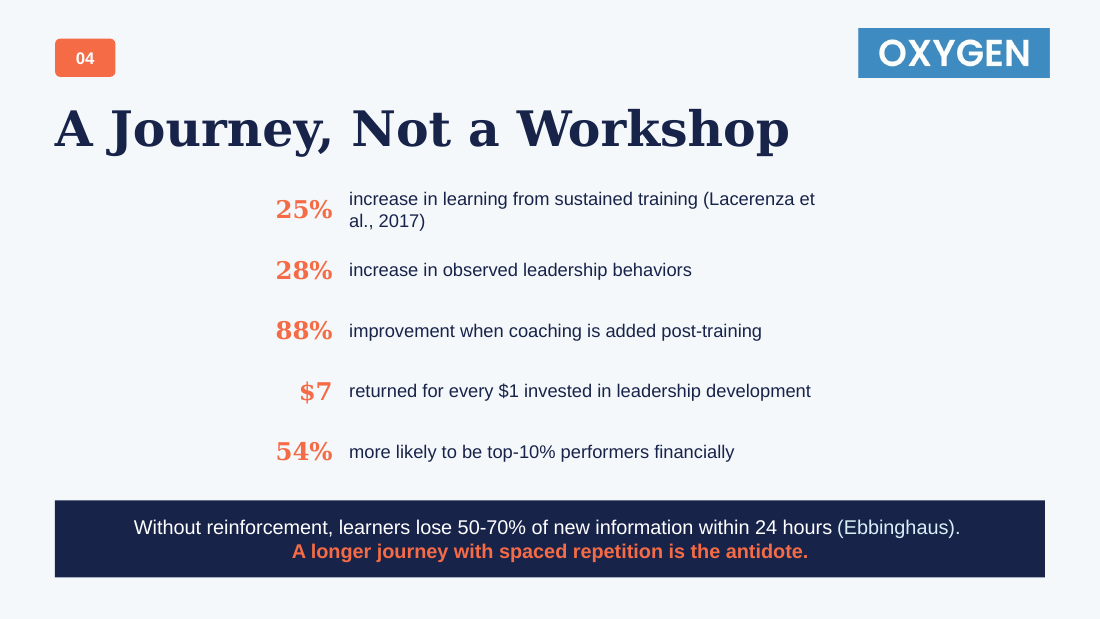
Sustained programs produce meaningfully higher learning and behavior change, and adding coaching afterward improves results dramatically. The business case follows: research points to roughly seven dollars returned for every dollar invested.
A great instructor changes everything. We all remember the difference one teacher made. I hated science in high school until a chemistry teacher completely changed my perspective on it. The same is true for manager development.
“Are you putting your team members on the tennis court with someone who’s never picked up a racket before?”
The best instructors aren’t facilitators reading slides. They’re experienced people who have managed real teams, made their own mistakes, and can show up with empathy while still holding managers accountable. Pair that with live instruction, where managers can’t hide and have to participate, and you create the conditions for real growth.
Real reps, not role plays. The most important shift is moving application out of the classroom and into the manager’s actual job. Managers learn a framework in a live session, apply it with their own team that week, report back on what happened, and refine with a coach.
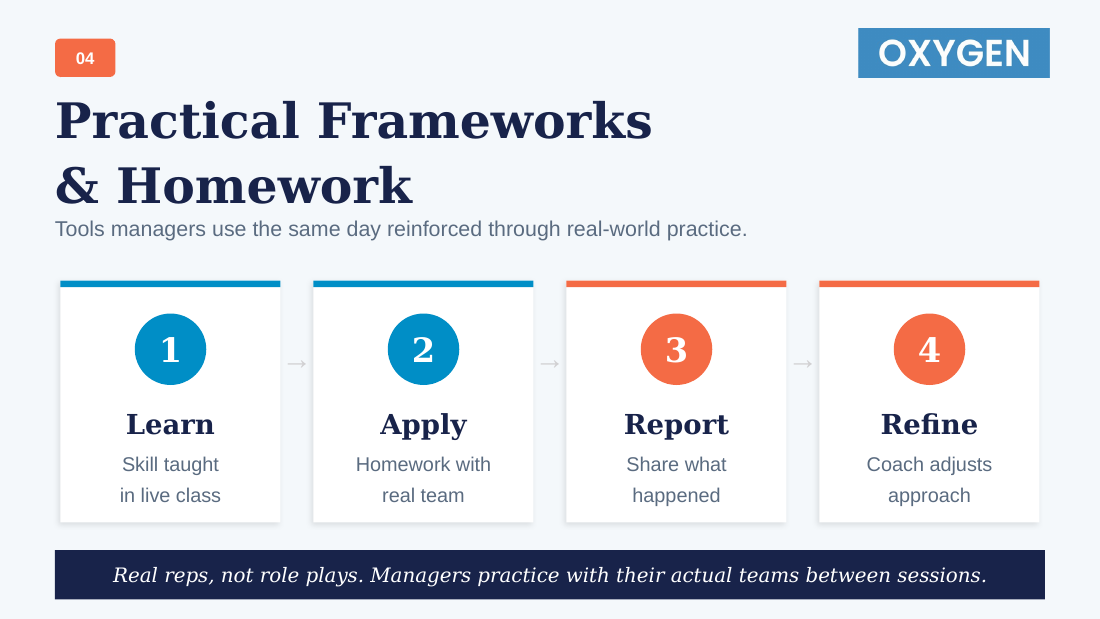
These are real reps with real stakes. In Management Essentials, for example, the first module covers accountability and delegation, and managers build a “clear role” for everyone on their team, defining the mission, key KPIs, and traits of each role. They leave with frameworks they use the same day, from situation-behavior-impact feedback to a 90/10 rule for one-on-ones, where the conversation is 90 percent about the team member and 10 percent your agenda.
One of our simplest frameworks shows how practical this gets. I once worked with a manager who felt like she was drowning every day. Her Slack never stopped: “Quick question,” “Can I run this by you?” “What should I do here?” She assumed her team lacked confidence. When we looked closer, the real issue was clarity. Her team had no idea which decisions they were actually allowed to make. So we introduced our Decision Tree.
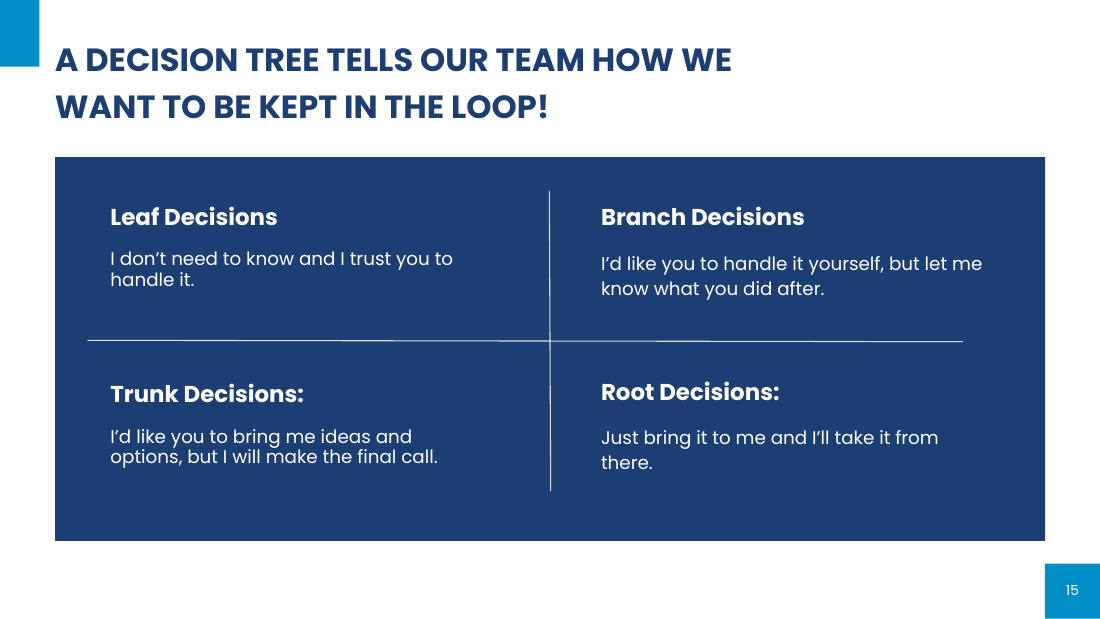
Damage a leaf and the tree is fine; damage the root and it dies. Leaf decisions are fully delegated. Branch decisions get handled, then reported back. Trunk decisions come to the manager with options before a final call. Root decisions always get escalated. Managers love this because it cuts down both micromanagement and constant escalation, and most organizations discover they’re escalating far more leaf decisions than they ever needed to.
Learning together removes the shame. Something powerful happens in a cohort. As I’ve watched happen over and over: one manager admits “I struggle with giving feedback,” ten others say “me too,” and the shame evaporates. Peer cohorts, Growth Groups, and confidential 1:1 coaching for the harder issues build a network that lasts well beyond any single session.
Supervisors are part of the journey. HR leaders increasingly need to show behavior change, not just attendance. The strongest programs build in a self-assessment and a supervisor assessment at the start, quizzes and reflection throughout, and a personalized development plan at the end. Keeping the manager’s own supervisor engaged the whole way, rather than just informed when it’s over, has been one of the biggest unlocks we’ve seen.
AI is starting to play a real role here, but not the one people often assume. It isn’t replacing human development. It’s supporting managers between sessions. Picture it: it’s 10 o’clock at night and you’re prepping for a 9 a.m. conversation. You can’t call HR and your supervisor isn’t available.
That’s why we built Toby, an AI course companion trained on Oxygen’s own curriculum rather than the open internet. Think of Toby as a tutor, not a coach: a context-aware, judgment-free space where a manager can rehearse a tough conversation using the same frameworks we teach in class and practice before the real thing. Human expertise plus always-available AI access means no manager has to face the hard moment unsupported.
There’s one more shift worth naming, about how we treat the transition itself. Becoming a manager isn’t just a job change. It’s an identity shift. You’re suddenly responsible not only for your own work but for the performance and development of other people. Yet most organizations mark that moment with little more than “Congratulations, good luck.”
My background is in rewards and recognition, so I’m always asking: how do we make this transition celebratory, and publicly acknowledge that becoming a manager is a real milestone and a real investment? The companies that get this right treat it as exactly that.
Here’s what gives me hope. Managers today are feeling less ready than ever, given the pace of change and everything being asked of them. But this is the first moment we can genuinely do something about it, with development that’s tailored, continuous, and built around practice. At Oxygen, our NPS runs around 90, and about 90 percent of companies that enroll their managers come back to enroll more.
Organizations don’t have a knowledge problem. Managers know the concepts. What they lack are structured opportunities to practice leading people, with support, in the moments that count. The companies that solve this will build stronger managers, stronger teams, and stronger cultures.
If you’re curious how large the application gap is in your own organization, that’s something we can measure fairly quickly, and I’d love to show you what closing it looks like.


.jpg)
.jpg)
.jpg)
.png)
.jpg)
.jpg)
.jpg)

